top of page
Alexander "Alexi" Peppas


Laser People Tracker for Gym Occupancy
Carnegie Mellon University Business Technology Group
Fall 2025 and Spring 2026: Hardware Design Lead


Hardware and Design Development as a part of the CMU Business Technology Hardware team alongside Ryan Shen, Arav Agarwal, Jason Malik, Lukas Yao, Shreyas Bharath, and Thiessen Coleman
During my senior year of undergrad, I was a part of a student organization called Business Technology Group. We would undertake certain product development tasks we believed would benefit Carnegie Mellon University students. One such project was called OpenGym. This project had been in the works for the last few years before I joined, and when I did, they needed people to help with hardware development. Being a mechanical engineer who enjoyed designing and building things, I joined and continued development on the people-trackers for OpenGym.
OpenGym is a web service that any CMU student can access, showing occupancy information for the gyms on CMU's campus. To properly track the number of people in the gym at any time, previous members created a people tracker.
This people tracker consists of two components: a transmitter and a receiver. The transmitter sits on one side of the doorway and shoots two lasers at the receiver box on the other side. Then, depending on which laser is blocked first by someone walking by, we can determine whether they entered or exited the gym.
As the hardware design lead, my responsibility was to continuously iterate on previous designs to create something robust, modular to accommodate future design changes, reliable over long periods, and easy to maintain if issues arise.
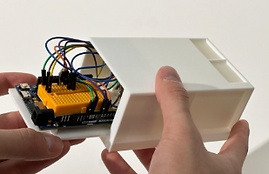
The initial designs were constructed from laser-cut plywood and glue. To make the design sleeker and more accessible, I changed it to one we could 3D print. To allow for easier access to the circuitry in case of an error, I changed the access point from a taped-on lid to a sliding rail mechanism built into the structure. The previous design was made to fit a specific doorway; however, I redesigned it to adhere to the back or sides of the box, allowing it to fit on any surface or doorway using command strips. As a result, the rails that let the shell slide on and off are at the front, keeping the box aligned on the wall. I also shrunk much of the extra space within the box to just what was necessary to fit the circuitry. I also increased the size of the receiver windows to reduce the likelihood that the lasers will go out of alignment over time.




bottom of page